


DIY weather stations have long been a popular project among electronics enthusiasts, but most results are frankly uninspiring. The typical approach involves pairing a single-board computer with an LCD display and a 3D-printed rectangular enclosure. While this proven formula delivers basic functionality, many of these builds end up gathering dust and being stripped for spare parts.
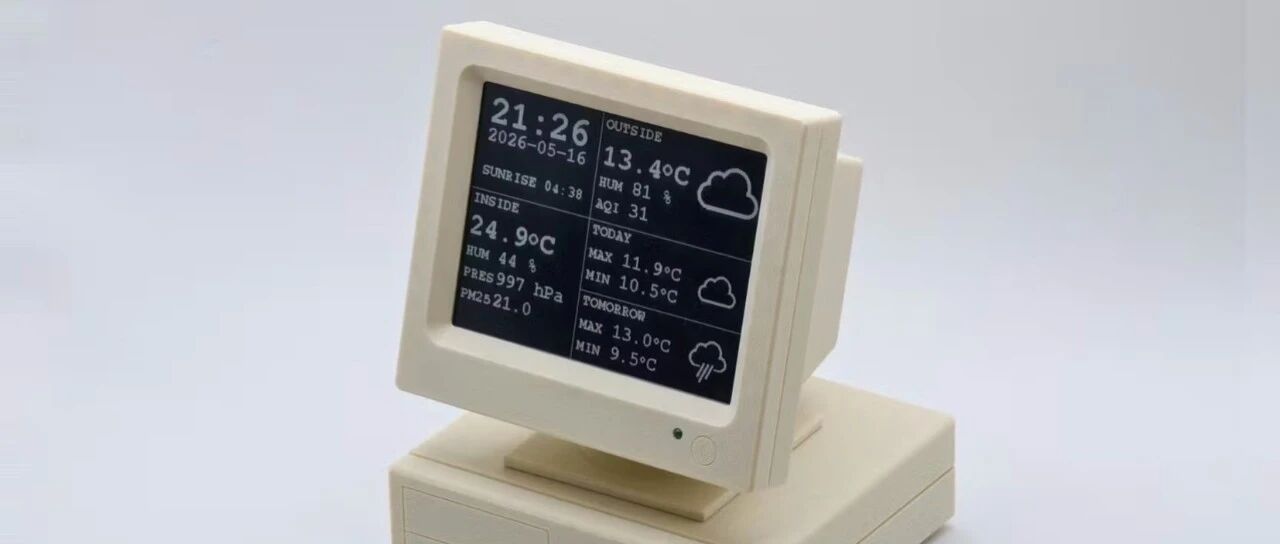
If you want to build a visually striking device you'd actually want to display on your desk or bookshelf, overseas maker Andrei Gorsky's latest creation — the Retro Mini PC Weather Station — is an outstanding choice. Powered by an ESP32 microcontroller, it packs weather station functionality into a 3D-printed miniature chassis that faithfully recreates the look of a 1990s IBM personal computer.
The device collects indoor environmental data via onboard sensors and can also fetch real-time outdoor weather conditions through third-party API integrations over Wi-Fi.
Hardware Highlights
Inside the chassis are an ESP32 development board, a WeAct 4.2-inch black-and-white ePaper display, a BME280 environmental sensor, and three indicator LEDs. Two of the LEDs simulate the power-on status lights of a vintage PC tower and monitor, while the third blinks during operation, faithfully replicating the classic hard disk activity indicator of early computers.
Software & Smart Integration
The firmware syncs weather and time data every ten minutes from the smart home platform Home Assistant, presenting a clean 2×2 panel layout with today's and tomorrow's forecasts, day/night weather icons, plus real-time meteorological data such as humidity, air quality, and sunrise/sunset times.
The onboard BME280 sensor independently measures indoor temperature, humidity, and barometric pressure without relying on Home Assistant. The collected data can also be synced via MQTT (Message Queuing Telemetry Transport) to a whole-home smart system, with automatic platform discovery supported. In other words, this mini weather station is not just a data display — it's a functional, connected device within a smart home automation ecosystem.
Easy Setup & Open Source
On first boot, the ESP32 automatically creates a dedicated Wi-Fi network and web-based configuration portal. Users simply connect via a browser to enter Wi-Fi credentials, Home Assistant API details, MQTT parameters, and display preferences.
Building your own replica is equally straightforward — the developer has open-sourced all resources: source code and documentation are available on code hosting platforms, 3D-printable model files can be downloaded from maker model platforms, and the entire project is freely available under the MIT open-source license.