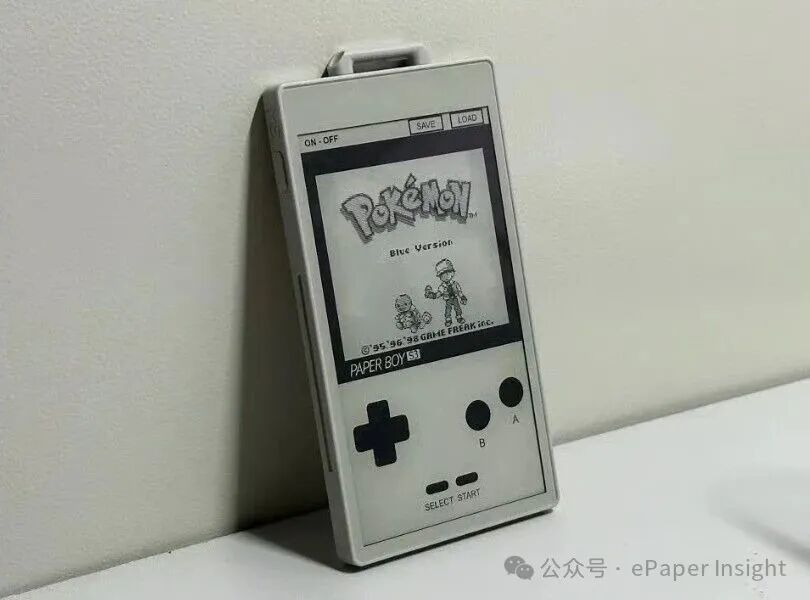


E-readers were originally purpose-built tools for text reading, relying on E Ink screens to deliver paper-like viewing and ultra-long battery life — they have never before intersected with the world of gaming devices. Yet one overseas maker has completed a remarkably creative hardware mod, deploying a Game Boy emulator on a standard eReader to run the original Pokemon Blue in its entirety. A video demonstration shows the game fully playable through to completion, shattering the widely held assumption that “E Ink screens cannot handle gaming.”
Unlike the countless clickbait videos on the internet that merely briefly load a ROM and show a few frames of gameplay before ending abruptly, this mod achieves a complete gaming experience. All core gameplay elements — overworld exploration, menu navigation, Pokemon battles — operate stably, delivering genuinely playable performance on a display technology inherently ill-suited for dynamic content.
From a hardware perspective, E Ink screens face unavoidable display limitations. The screen relies on the physical movement of charged ink particles to refresh pixels, with a single refresh typically taking 120 to 250 milliseconds — equivalent to a mere 4–8 fps, far below the original Game Boy's 59.7 fps standard. Fast-action games would suffer severe ghosting and stuttering. However, the original Pokemon Blue happens to be a perfect match for the E Ink screen's constraints: as a turn-based RPG, the game only involves slow-paced walking on the overworld with no high-speed scrolling; text boxes and menus dominate the gameplay, and battle animations consist of simple sprite flips, demanding very little dynamic visual performance. The low refresh rate that would be fatal to side-scrolling platformers or shooting games produces only minor visual artifacts in this dialogue-driven retro title, with no impact on actual playability.
The key optimization enabling this smooth experience is the use of partial screen refresh mode. The developer abandoned the traditional full-screen redraw logic of E Ink displays and instead updates only the regions of the screen where pixel changes occur, dramatically reducing ghosting and flicker while boosting the effective frame rate. When navigating town maps such as Viridian City, movement appears smooth and natural. The article also identifies the overall performance bottleneck: current mainstream eReader processors are fully capable of running 8-bit Game Boy emulators smoothly. The constraint lies entirely in the E Ink screen's refresh speed, not in computing power — which also explains why turn-based games are far better suited to E Ink devices than fast-action titles.
In fact, second-hand eReaders are highly promising platforms for retro emulation, offering several advantages that dedicated handhelds cannot match. First, battery life is overwhelmingly superior: E Ink screens consume virtually no power when displaying static images, allowing weeks of continuous use on a single charge, far exceeding the few hours offered by smartphones or retro handhelds. Second, outdoor visibility is outstanding — the reflective, backlight-free display remains perfectly clear even under direct sunlight, whereas LCD screens become nearly unreadable in bright conditions. Third, devices are widely available and modification costs are low: there is a massive inventory of second-hand eReaders, most of which run Linux-based systems that allow free installation of third-party emulator software. Fourth, the unique atmosphere of gameplay aligns perfectly with the nostalgic feel of the original Game Boy, with no harsh backlight, soft and quiet visuals, and a slower-paced experience that suits the casual, relaxed ethos of early handheld gaming.
This mod also redefines the criteria for evaluating retro gaming hardware: whether a device can smoothly run a game depends not only on processor performance but equally on how well the game's genre matches the display hardware. The 1996 release of Pokemon Blue, when played on an E Ink eReader, delivers an experience that actually surpasses certain cheap retro handhelds running fast-action titles.
Of course, this modding approach still has clear limitations. On the hardware side, it only adapts to the grayscale original Pokemon titles — GBA color games like Pokemon Ruby become nearly unidentifiable on a grayscale E Ink screen due to extremely poor color differentiation. On the genre side, it is only suitable for turn-based and text-adventure style slow-paced games, and cannot handle platformers or shooters that require rapid visual feedback. Future enthusiasts could extend compatibility further by iterating on ghosting-reduction algorithms and adopting multi-color E Ink devices. As it stands, the device is better suited for fragmented commutes to revisit the Kanto region storyline, offering a light nostalgic experience.
Overall, this DIY modification is not a gimmick chasing internet traffic but genuinely broadens the thinking around retro gaming hardware mods. The E Ink screen and the original Pokemon Blue form a surprisingly complementary pairing, using a low-cost, long-battery-life reading device to create a uniquely nostalgic gaming experience, and opening up entirely new directions for retro emulator enthusiasts.